Экспорт шин в Китай растут, цены падают
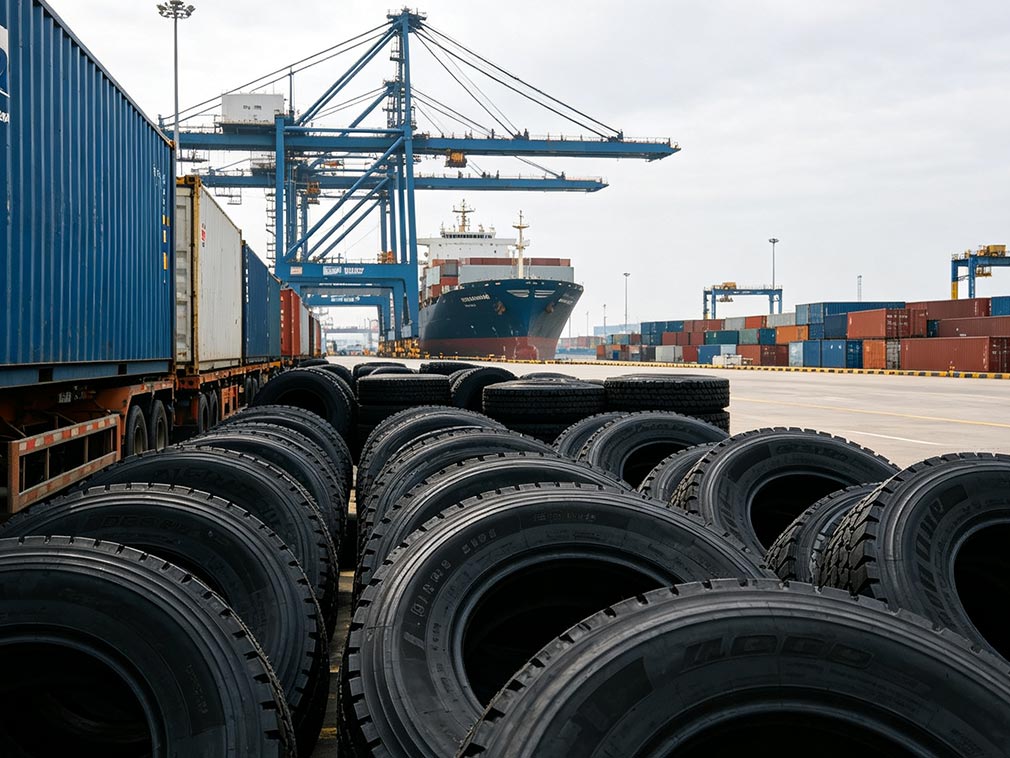
According to the latest data from the General Administration of Customs of China, China's export of rubber tires in the first half of 2026 reached 4.94 million tons, an increase of 4.9% compared to the same period last year; the export value was 82.6 billion yuan, a decrease of 1% compared to the previous year.
Among them, the export of new pneumatic rubber tires was 4.75 million tons, an increase of 4.7%, with a corresponding value of 79.1 billion yuan, a decrease of 1.2%; in quantitative terms, the export amounted to 362.42 million tires, an increase of 3.9%.
The export of automotive tires was 4.18 million tons, an increase of 3.3%, with a total value of 66.5 billion yuan, a decrease of 3.1% compared to the previous year. Despite the continued expansion of export scale, the average price has significantly decreased, highlighting the characteristic of "trade volume in exchange for price."
Market competition remains fierce
China has always been a region of intense global competition in the tire market. Although the overall export volume continues to grow, many world economies continue to impose trade barriers, and the domestic tire market is also deeply mired in internal struggles. Especially in the past two years, foreign brands have successively exited the all-steel tire market, making competition among domestic tire companies increasingly fierce, and the fight for existing market share has become the norm.
Trade barriers are becoming more complex, narrowing export channels
According to reports from foreign industry media on July 15, 2026, the U.S. Department of Commerce completed a review of anti-dumping and countervailing duties on Chinese passenger car and light truck tires, deciding to extend them for another five years. These duties, imposed since 2015, have a cumulative rate of nearly 190%, which has long suppressed the direct export of products from Chinese factories to the North American market.
Earlier, on June 18, the European Commission issued the final decision AD733, imposing anti-dumping duties ranging from 24.4% to 45.3% on Chinese passenger car tires. In addition to Europe and the United States, Brazil and Peru have also initiated anti-dumping investigations on Chinese tires; the Eurasian Economic Union has further increased entry costs through strict environmental standards.
Exports to the U.S. have sharply declined
In the first five months of 2026, the U.S. imported a total of 116.59 million tires, a decrease of 3.6% compared to the same period last year. Imports of passenger car tires amounted to 69.98 million, a decrease of 2%; truck and bus tires — 24.71 million, a decrease of 9%; aircraft tires — 135 thousand, an increase of 22%; motorcycle tires — 1.54 million, a decrease of 2%; and bicycle tires — 3.28 million, an increase of 24%. During the same period, the U.S. imported only 7.44 million tires from China, a decrease of 33% compared to the previous year.
Passenger car tires accounted for 409 thousand, a decrease of 14%; and truck and bus tires accounted for 382 thousand, a decrease of 41%. Under the influence of high tariffs, Chinese tires are rapidly being marginalized in the U.S. market.
The domestic original equipment market under pressure
According to statistics from the China Association of Automobile Manufacturers, in June 2026, the country's automobile production and sales were 2.76 million and 2.81 million units respectively, a decrease of 1.2% and 3.2% compared to the same period last year.
Among them, the production and sales of new energy vehicles were 1.598 million and 1.643 million units respectively, an increase of 26% and 23.6% compared to the previous year. From January to June, the cumulative production and sales of automobiles were 14.993 million and 15.017 million units respectively, approximately 4% less than the previous year.
In the commercial vehicle sector, production and sales in June were 387 thousand and 409 thousand units respectively, an increase of 9.5% and 10.7%; cumulative production and sales for the first half of the year were 2.272 million and 2.297 million units respectively, an increase of 8.2% and 8.3%. The overall reduction in automobile production directly puts pressure on the demand for original tires.
Retail stores: weak recovery, profitability remains challenging
The replacement market also remains bleak. Recently, Tire Business visited several tire shops in Beijing. One shop owner frankly stated: "There are indeed a few more customers than in the past two years, but that's because the market was really bad in the past two years. The problem is that the average transaction cost has not increased; overall, business is still not good. Compared to the past two years, it's a little better, but just a little." Visits show that the retail tire market in Beijing has not undergone significant recovery; competition remains the norm, and the low-price strategy to increase volume continues.
Competition enters a more complex phase, companies need to adapt
With increasing export volumes but declining prices, high trade barriers, and sluggish restructuring of the domestic automotive market and replacement demand, the tire industry faces numerous challenges as it enters a phase of low-margin, high-intensity competition. For companies, the real test will be how to increase product added value, optimize the global allocation of production capacity, and maintain profitability in a saturated market.
-
Экспорт зеленой техники вырос на 21,7% (19 августа)5295
-
Немецкие полуприцепы достигли €40 тыс. в соответствии с правилами ЕС (19 августа)6392
-
Китайские электрические грузовики: более 16,000 экспортировано за 4 месяца (19 августа)6972
-
Цены на шины растут вслед за увеличением расходов (18 августа)6504
-
Будет ли зарядка электромобилей проще к 2030 году? (18 августа)6871